
Why you shouldn’t over-complicate the first day (and what you can do instead).
The first day of math class used to be so nerve wracking. I kept remembering that old saying about never having a second chance to make a first impression. I knew not to dive into content on day one but I’d be torn between doing something super fun so kids would have a good attitude toward their new math class and diving right into procedures and the syllabus.
Then, a few years in, I realized that the first day was just a blur for students because at the end of the day, they had six or more other “first day” experiences in all their other classes. I also learned that most 8th graders were still on their summer schedule and were waking up early for the first time and, as a result, were really in no mind to actually learn or remember anything. So I now know that procedures are better taught over the course of several days. Typically, I try to explain only one or two each day so it isn’t overwhelming and doesn’t get forgotten in the “first day blur.” For example, day one I might explain what they need to have everyday when class begins and day two I might explain how to get note copies if they are absent , etc.
In short, diving into all procedures and my syllabus would have to wait if I actually wanted them to remember any of it and there was really no sense in planning something too overly complicated since it was to be soon forgotten in the first day whirlwind anyway. Ok so what do I do on day one? Well, I have a few super easy activities ideas that I choose from that really take no prep but that leave students with a positive feeling, which is all I really want to accomplish in 45ish minutes anyway. Here are some of those ideas, in no particular order.
Stand Up/Sit down: Just ask a series of questions and have them stand up if their answer is yes to each question. I ask things to see who is new to the school (or district), who is in the band, who traveled out of state over the summer break, etc. All you have to do is think of questions so it is super easy and gives you a chance to informally learn about your class as a whole.
Draw a Pig Personality Test: For this one I give a half sheet of blank copy paper and I make sure I have some pencils available. This personality quiz has been around for years. I only give them only about a minute and I slightly change some of the interpretations. For example, before I explain the interpretation of tail length, I always ask first if anyone drew their pig without a tail and have them quickly add one and then I tell them that the length of their pig’s tail indicates how well they will do in my math this year. Since the longer the tail the better, I always have them imagine its length uncurled because most will have drawn it curly.
Life with the Wright Family: I got this one from a colleague years ago and it is a go to favorite. I create groups of about 4-6 students and have them stand or sit together. Each group has one simple object like a number cube or whatever I have available. Then, I read the story from page two of this site and have them pass the object the appropriate direction whenever they hear a directional word, which in this case is “left” “right” or “Wright.” As I read, they try to keep up correctly passing the object to the left or right in their group. I typically start reading slowly and get faster as the story goes.
I find these quick and easy for a day one activity. If I have any extra time, I just let them ask questions about me or the class and I spend time trying to remember all their names.
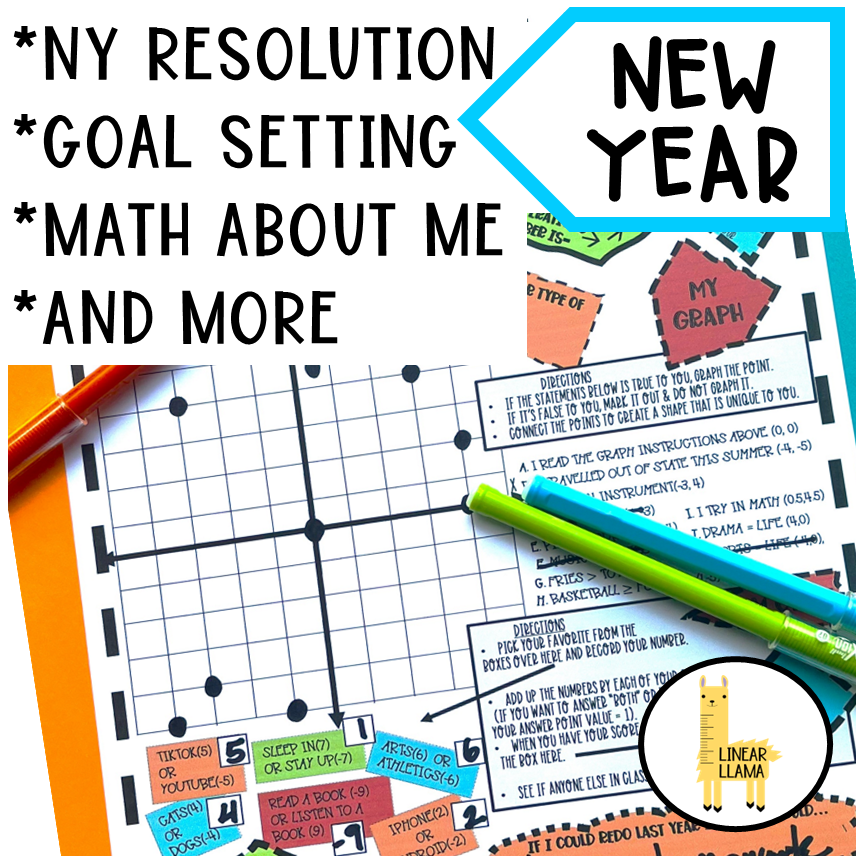
If you are looking for more, I have made a back to school Math About Me activity that I use typically on days two and three to ease students into math and get to know them a bit better. It also includes another personality test designed for math classes and a Find Someone Who icebreaker game. You can find it linked here in my shop. I have made it so that it can easily be used with incoming 7th or 8th grade math students and I’ve recently added some resolution and goal setting activities to it that make it great to use in January at the start of second semester.
 LINEAR LLAMA
You must be logged in to post a comment.